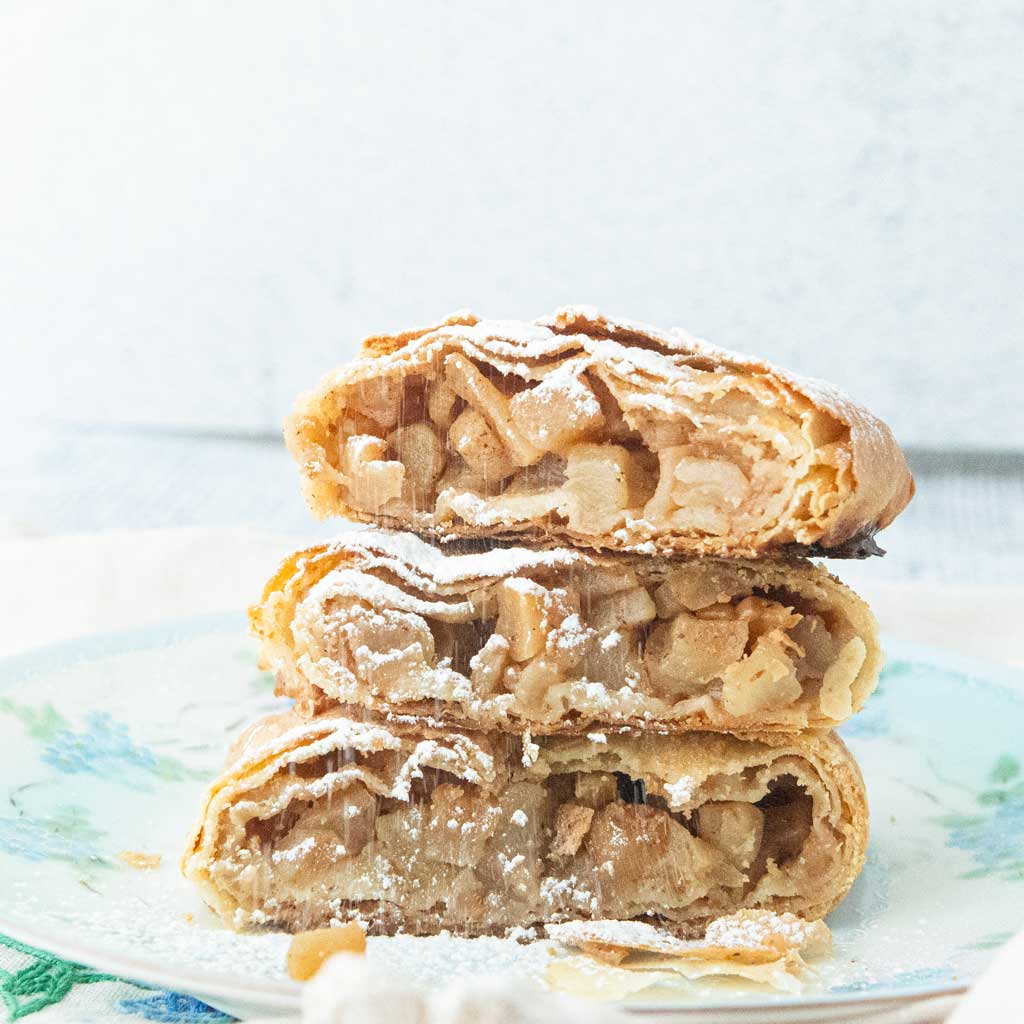
Traditional Apple Strudel Recipe: A Project Worth Your Time
My traditional apple strudel recipe is possibly the best thing I make: filled with juicy perfectly caramelized apples inside a traditional pulled strudel dough that bakes into beautifully crisp paper thin layers that transcends pie by a country mile.
| Taste | Texture | ||
| Vanilla cinnamon apples, buttery pastry | Crisp pastry, tender apples |
| Active time | Total time | Yield | Difficulty |
| 45 minutes | 3 hours, 15 minutes | 1 large Strudel or 2 smaller ones | Difficult but doable |

I Won’t Lie About The Difficulty, But That’s Why I’m Here
I have to walk a fine line here: strudel is not a beginner baking project, but it is totally doable. As someone of German and Czech heritage, it makes me very sad to see cheater recipes for strudel made with phyllo dough or puff pastry. While those are perfectly edible, in my mind they’re not strudel. Traditional pulled apple strudel is an art. The dough is not quite like phyllo and certainly not fatty enough to be puff pastry. It is its own thing and there is beauty and difficulty in that.
My goal here is to show you how to make strudel step by step and to convince you that it is in fact possible. While I don’t believe that this should be the first baking project that you attempt, it is a worthy goal. Follow the steps and just try. 20 years ago I was a beginner with strudel too, and I learned, getting better with each round.
Don’t let this intro be a disclaimer. You can make lovely strudel, and I’m here to help.

What Is Strudel?

Strudel is a pastry made with a dough with a small amount of fat that is stretched until paper thin over a table. Fillings are scattered on top of the dough and then the dough is rolled up into a log, making layers of pastry that enclose the filling.
Strudel literally means “whirlpool” in German after the process of rolling the dough progressively around the filling.
A slice of strudel tastes not unlike a pie, though the slices are much more free form and the pastry is much less fatty but more crispy.
Fillings can be sweet fruit, or savory fillings. Apple strudel (Apfelstrudel) is probably the most famous sweet filling and cabbage is probably the most common savory filling. You could easily take the dough from this recipe and the filling for krautburgers and make an incredible dinner strudel!
Apple strudel is typically made with thin slices of raw apples rolled up. I however, buck tradition and use a cooked apple filling (see why below).
My Family’s Strudel

My great-grandma, Bee was the strudel maker. She learned how to make it from her mother and Lord knows how many generations before them in Germany. I have an article in my kitchen written before I was born about my Grandma making strudel in her hometown of St. Joseph, Missouri. I read it every time I make strudel, and it reminds me that this isn’t just a recipe but a piece of my family’s history.
Grandma St. Joe as we called her made two types of strudel–the traditional pulled strudel and also a yeasted version. I think the yeasted version kept longer and could be made at a moment’s notice with fewer ingredients. As such, she sent it home with visitors usually with a pot of stuffed peppers if she could fit them in a suitcase (something she was famous for doing).
Whichever version you got to eat, strudel was always special, it was always a celebration type pastry that fed a lot of people in one go.
My Secret to Crisp Apple Strudel Is Cooking The Apples
"Cream-colored ponies and crisp apple strudels
Doorbells and sleigh bells and schnitzel with noodles
Wild geese that fly with the moon on their wings
These are a few of my favorite things"
--"My Favorite Things", from The Sound of Music by Rodgers and Hammerstein
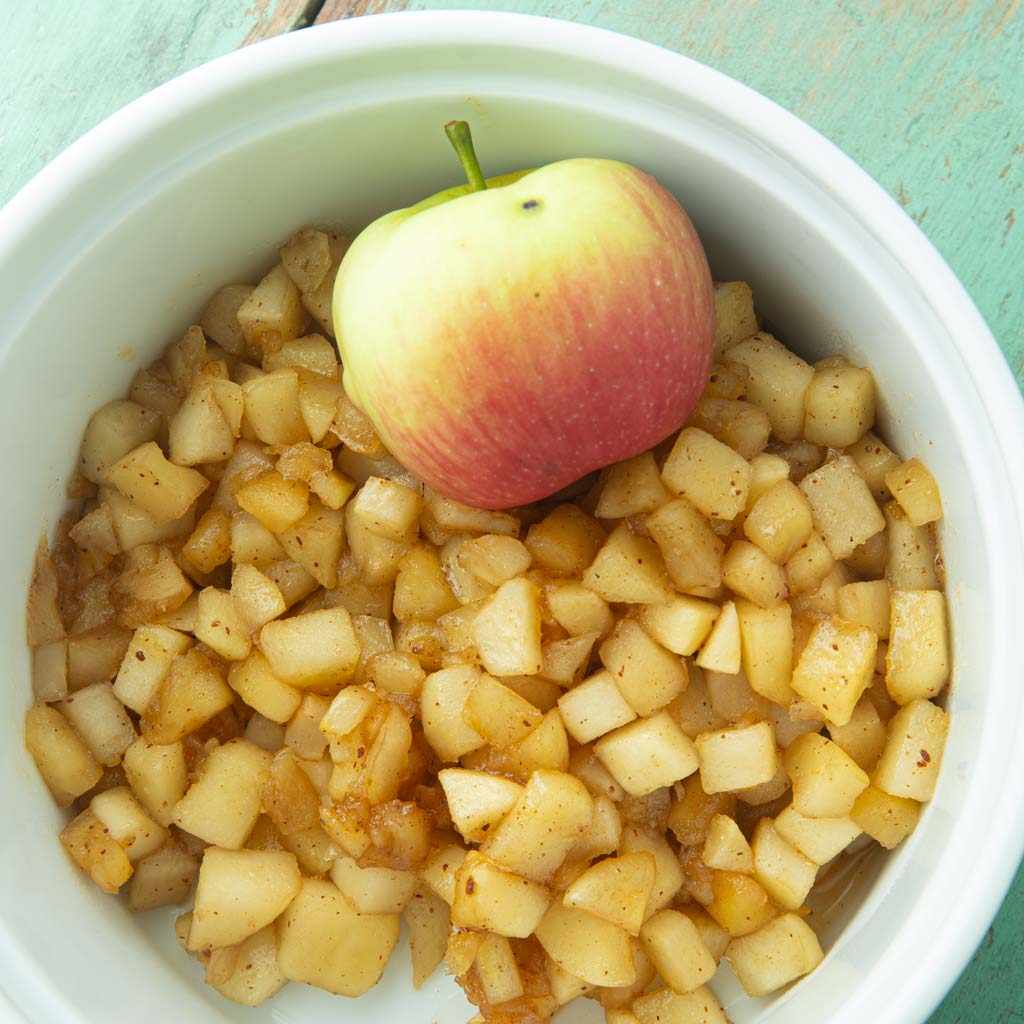
To me the goal of strudel is for the pastry to be crisp and the apples to be tender. This is very hard to do. Apples, like other fruits weep out juices when sugar hits them. Because of this, it’s very easy for the pastry to get waterlogged, leading to potentially sad, uncrispy strudel.
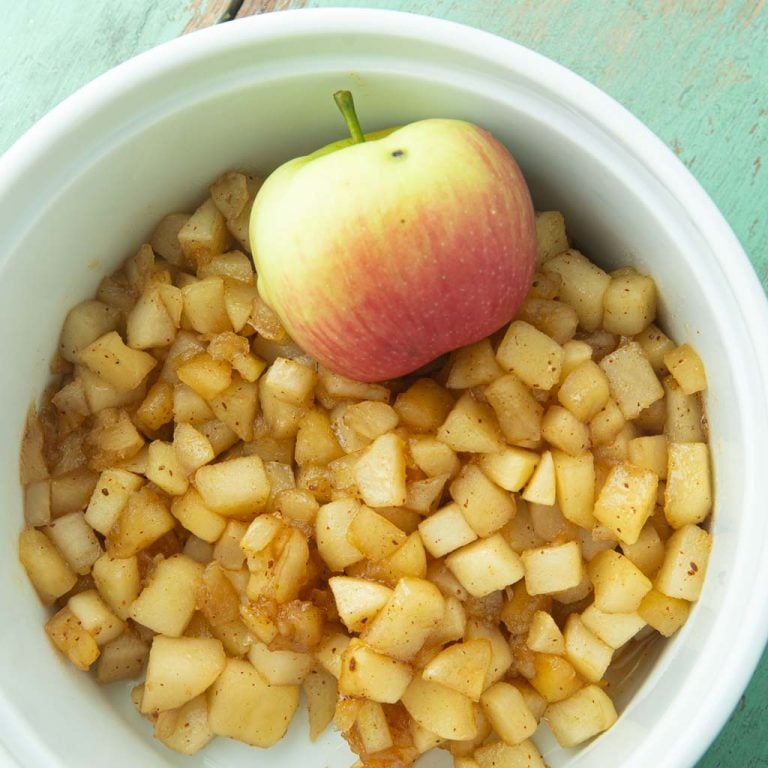
In my 20 years of making strudel, I’ve come to cook the apples first in my make-ahead apple filling. It adds a whole lot of flavor to the apples you can’t get by putting raw apples, but it also ensures that you get crisp pastry. This is because the filling does not need to bake any longer and is not glutted with free running juices that could sog up your pastry.
Why Strudel Dough Is So Special
Strudel dough is in a class by itself. Phyllo is probably the closest thing to it, yet it’s not quite the same. Commercial phyllo is typically thinner than strudel could ever be (and is for the few masters who pulls the phyllo by hand). Strudel needs to be thin but also strong enough to roll into a log.

The dough has a little bit of fat and a higher amount of protein. This extra protein (from bread flour) gives the dough a little more stretch and malleability that allows you to stretch the dough progressively until it is as thin as paper. You should be able to see the pattern of the tablecloth you work on underneath the dough.
While it’s possible to mix the dough by hand, it’s easier for beginners to use a mixer to make the dough.

Apple Strudel Ingredients
Filling
- Make ahead apple filling
Dough and Finishing
- Bread flour: used for the higher protein content
- Lard or butter: lard makes for a more supple dough.
- Egg yolk
- Sugar
- Salt
- Water
- Melted butter
- Bread crumbs: bread crumbs absorb any excess liquid from the filling and add additional texture
- Cinnamon sugar
Unusual But Essential Equipment For Making Apple Strudel
- Tablecloth: It might seem weird, but the dough is pulled on a tablecloth. The tablecloth gets floured so that the dough does not stick to it. A natural fiber tablecloth made from either 100% cotton or 100% linen is ideal. I have a trunk full of vintage tablecloths I started collecting solely for strudel.
- Card table: While you can work on a counter, it’s nice to work at a square table. You can easily access all sides of the dough. Use a counter or whatever the widest surface you have available to you.
- Pastry brushes: You’ll need 2 here. Use one for brushing on butter, and keep the other one dry for brushing OFF flour.
Pro Tips for Making the Best Apple Strudel

- You must rest the dough: Once you’ve made the dough, it needs to rest for a couple hours. In that time, the gluten will relax, getting it ready to stretch.
- The dough has 4 sides: As you stretch the dough, think of it having 4 sides. Work your way in a circle around those 4 sides, stretching only one side at a time. It’s crucial to not rush the stretching.
- Use the backs of your hands, not your fingertips: To stretch the dough, gently slide the backs of your hands under the center of the dough on one side. Gently slide your hand outward towards the edges. The dough will stretch gently. Only when you get to the very edge of the dough should you grab the dough delicately with your fingertips. The edge is always thicker and needs a little more stretching. By pulling on it slightly and letting it drape over the edge of the table, the weight of the dough will continue stretching the dough until you stretch the dough next.
- Take your time: Do not rush pulling the dough, or you will get tears and may risk toughening the dough. Let the dough tell you when it’s been stretched enough. When it starts to resist, go to the next side. By the time you’ve moved around the table, any one given side will have had time to relax enough where it will be ready to stretch more.
- Holes are inevitable; your attitude towards them is a choice: Do not give up if your strudel gets holes. Most holes are towards the edge of the dough and can be worked around. Strudel is difficult to master, but keep practicing. My great-grandma used to say, “If you get the dough without any holes, that’s a good day!”
Budget Your Time When You Make Strudel
I won’t lie, this recipe is a project. It’s a good project that’s worth every second of your time, but don’t make this on a day you’re rushing around. Here’s how to budget your time.
- Make the apple filling ahead: I do this all the time. Having a batch of apple filling ahead of time means you can kick your feet up or do other things while your dough is resting. Because this is an on-your-feet kind of recipe when it comes to the dough, any minute you can save is worth doing.
- Give yourself 30 minutes for stretching and filling the dough: The first couple times you stretch the dough, budget 30 minutes. I can stretch it in less time, but if it’s very cold outside, sometimes I need every last bit of that time. You must be in a relaxed mindset to do a good job stretching the dough, and knowing how long it will take is one step in that direction.
- It takes an hour to bake: Big strudels take big time to bake. I never make a strudel with less than 3 pounds of apples’ worth of filling. Budget an hour for baking. 5 pounds of filling absolutely takes every last second of that time, and slightly smaller ones are in the 45 minute range.
- Keep your tools with you: I keep my dry brush for brushing off the pastry in my apron pocket. Keep your wet brush in the pan of butter ready for brushing. Have your sheet pan lined with parchment near your work area as well as a paring knife for cutting off excess dough. Having your tools handy will keep you from rushing around.

Traditional Apple Strudel
- Total Time: 3 hours 15 minutes
- Yield: 18 pieces 1x
Description
There is nothing under the sun that beats perfectly crisp apple strudel. Practicing this dough is 1000% worth your effort. Once you get it, you’ll want to toss out every apple pie recipe you own; it’s that good and better.
Ingredients
Filling
Make-ahead apple pie filling with up to 5 pounds of apples
Dough
- 2 cups bread flour (260 g)
- 1 large egg yolk
- 1 Tablespoon sugar
- 1/2 tsp salt
- 3/4 cup hot water (177 mL)
- 2 Tablespoons melted lard or butter (28 g) plus 1 teaspoon for the dough
For finishing the strudel
- 1 stick butter, melted (113 g)
- 1/2 cup fine bread crumbs
- 1/4 cup granulated sugar
- 1 teaspoon ground cinnamon
Instructions
Make the dough
- Mix all ingredients in a mixer bowl with the paddle attachment. Beat the dough for 10 minutes until it is extremely pliable and pulls away from the side.

- Place the teaspoon of extra lard over the dough and rest it for at least 90 minutes, covered with a bowl you’ve warmed for a few seconds on the stove. Place the dough in a warm spot with no drafts.



Stretching the dough
- Use a small sieve to sprinkle a cotton or linen tablecloth on a large counter or card table. Rub the flour into the cloth, making sure that the tablecloth is covered with a fine layer of flour.
- Sprinkle a small amount of flour on the dough, and then begin patting it into a rectangle with your hands. Do not knead the dough.
- Flour the backs of your hands (take off your rings), then gently stretch the dough until it resists. When the dough springs back, stop. You can hang it off the end of the table to encourage it to stay stretched, but once it resists you, leave it.
- Continue to pull the dough, moving clockwise around the table, pulling one side of the dough at a time. Do not rush this process. Always move at the speed of the dough, never coaxing it to stretch faster than the time it takes to recover.
- Gradually the dough will get thinner and thinner. You’re shooting for the dough to be transparent and about 3 feet by 3 feet. You should be able to see the pattern of the tablecloth beneath the dough.
 Rub the flour into the cloth, making sure that the tablecloth is covered with a fine layer of flour.
 Do not knead the dough.


Finishing and baking the strudel
- When the dough is fully stretched, use your wet pastry brush to gently brush the melted butter over the entire surface of the dough. Get down at eye level to make sure that every inch of the dough is brushed.
- Scatter breadcrumbs over the butter.
- Mix the sugar and the cinnamon and keep it handy.
- Choose one edge and place all of the apple filling about 6″ from the edge in one long log shape.
- Tuck the dough over the apples, using the edge of your hand to tamp down the edges, sealing in the apples. Brush off the excess flour with your dry brush, and then brush it with butter (wet brush). Sprinkle cinnamon sugar over the buttered top of the log.
- Grab the tablecloth firmly along the width of the strudel and quickly flip the dough back onto itself.

- Brush off the excess flour, butter the next flip of the strudel, and add cinnamon sugar as before.
- Continue to flip the strudel, following the same steps until you get to the end of the dough. Tuck the last bits of dough under the strudel.
- Use a knife to cut off the ends past the filling. You can cut these ends into smaller strips and bake them on your sheet too. Strudel ends are the best!
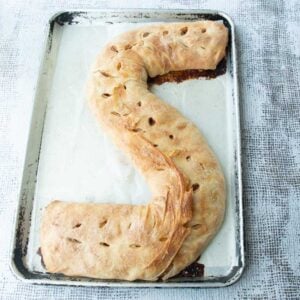
- Lift the whole strudel carefully onto your baking sheet, forming it into a letter S (for strudel!). Cut small vent holes with the tip of a knife along the whole length.
- Bake for 55-60 minutes or until the strudel is crisp and a lovely golden brown.
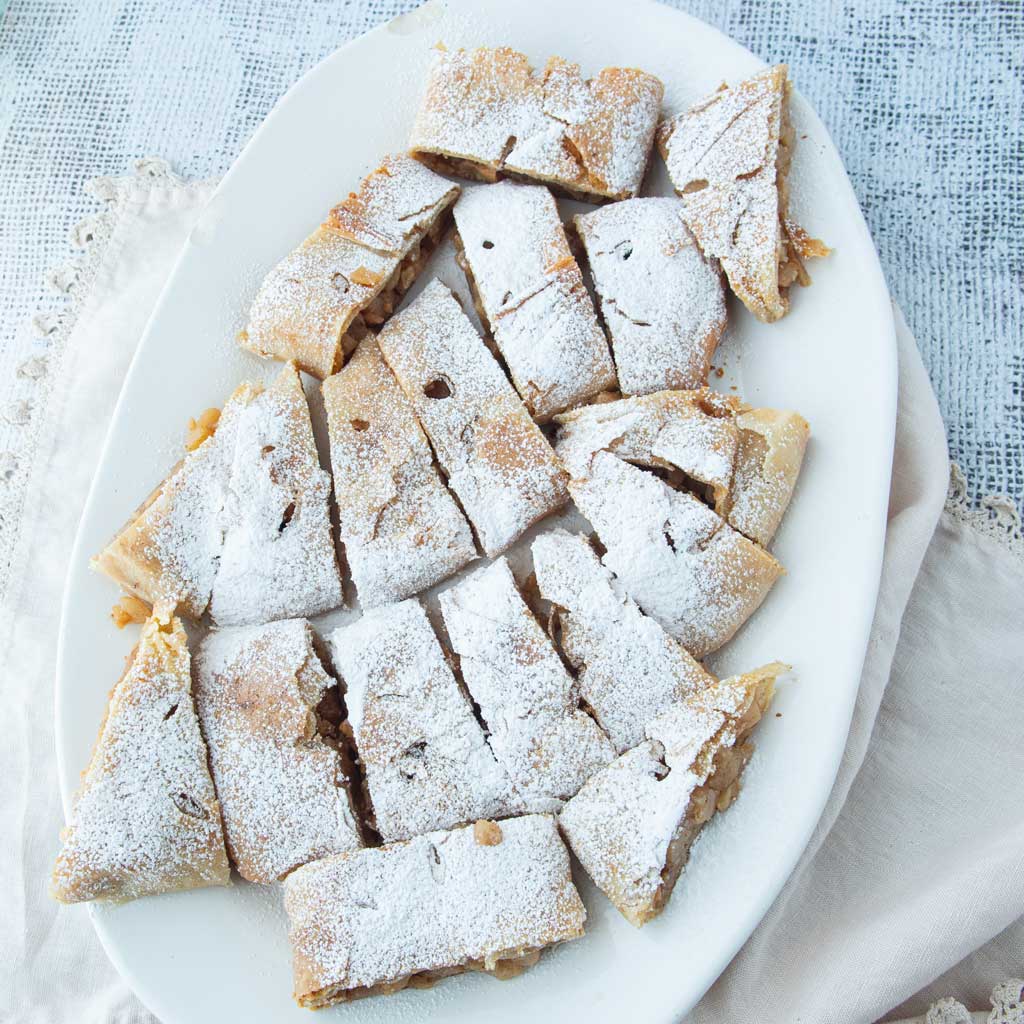
- Dust with powdered sugar before cutting into slices.




Notes
The heroes of crispness: breadcrumbs and the raisins in the filling are here in the strudel to absorb any extra juice from the apples. As much as we love juicy apples, the juice here can easily seem down into the pastry, keeping it from getting crisp. If you are firmly in the raisin haters camp, use another dried fruit in the filling such as sour cherries or apricots. Likewise, the breadcrumbs also absorb more apple juice and add some subtle texture. Grind up old stale bread in a blender or use panko breadcrumbs. If you don’t want to use breadcrumbs but you want the texture, use ground almonds or hazelnuts.
Pear Strudel: (Birnenstrudel): Instead of apples, you can either make a batch of the apple filling or you can peel and very thinly slice about 4 pounds of pears. Scatter them with the breadcrumbs across the strudel dough, sprinkling them with the cinnamon sugar, not just in one spot and then roll up the dough per the instructions. Pear strudel is a little more delicate than apple and absolutely incredible in its own way.
- Prep Time: 45 minutes
- Cook Time: 60 minutes
- Category: Pastry
- Method: Oven
- Cuisine: German